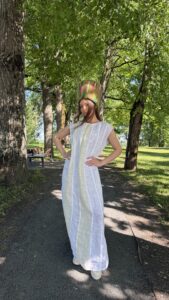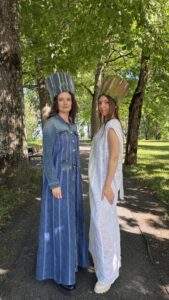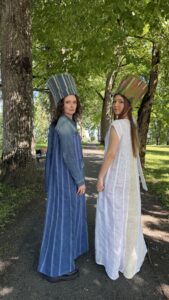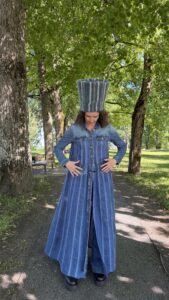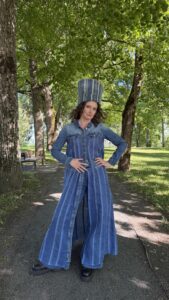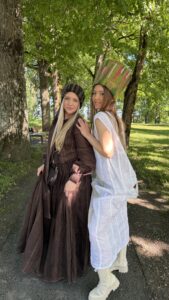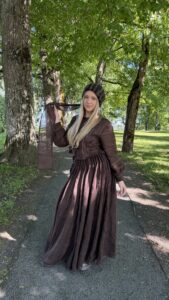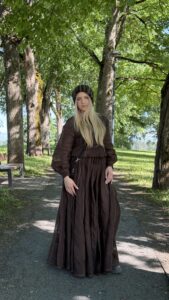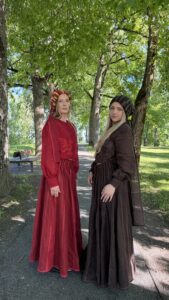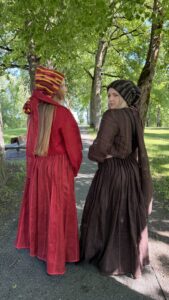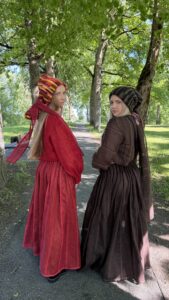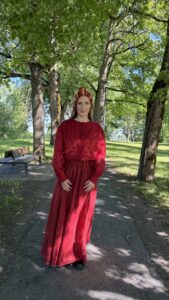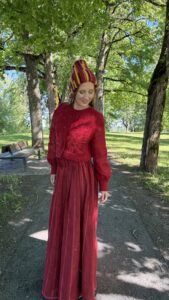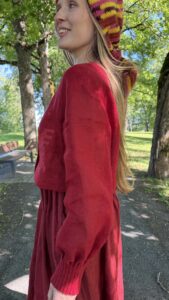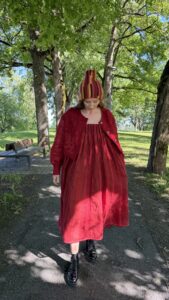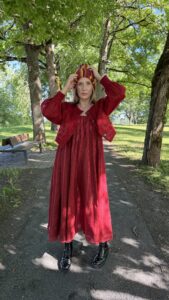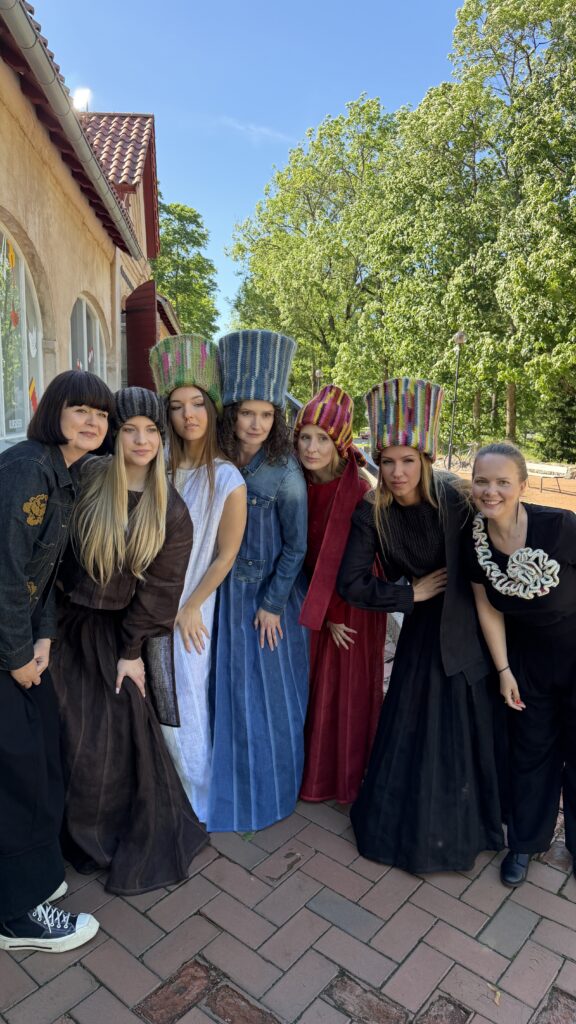
The collaborative collection for the OmaMood show has been created by two craftspeople.
Katre Arula: By valorizing production waste and used clothing, designer Katre Arula creates new unique items inspired by Estonian heritage. The entire creation process takes place in a small workshop located in the Põltsamaa castle courtyard, where each product receives a master’s touch. The designer makes products in very small quantities, which makes them unique and exclusive. In the street scene, Katre’s creations are recognizable by her author’s techniques: glove-printing technique or pixel technique, hidden button technique and felt roses.
Liis Burk: At our home, the Lahemaa Heritage House, we raise Estonian country sheep to keep alive and continue to breed our native wool sheep breed. In my new creations made with ancient technology – needlework, I use only half-worsted yarn made from wool from my own sheep, which is processed in a small Estonian wool mill and the yarn shades are natural or naturally dyed. The wearer of needlework items appreciates our heritage, perceives the slowness of the process of making the item, and enjoys the warmth of the natural material.
NÕELAPISTELINE
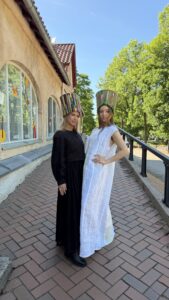
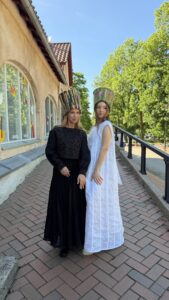
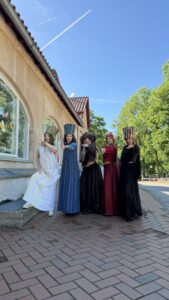
The collection consists of five sets. The names of the items are derived from our colorful calendar months, the different shades of which are reflected in each set. MAY – emergence, JANUARY – the celebration of light at Midsummer’s Eve, JULY – July’s beach fun, AUGUST – the August flower scene in the flowerbeds, and MICHAEL – the darkness that Michaelmas brings.
The collection brings together natural materials – linen and wool, which are the mainstays of our heritage textiles. Linen garments with a national silhouette have quilted patterns that carry forward our life patterns like a memory stick. The thinly woven linen fabric is a symbol of transparent fashion with its translucency. Needlework accessories draw attention to a technique that has long been in history and once warmed the bodies of our ancestors.
Is the collection related to heritage and Estonian craft traditions?
The collection combines natural materials – linen and wool, which are the mainstays of our heritage textiles. The cuts of the garments imitate our folk costumes, where the inspiration is striped skirts, woolen jackets, gathered sleeves, tunics, etc. The needlework accessories are made using heritage craft technology that is rarely used today.
What inspired you to create the collection?
First there was Liis, who said let’s do something together…
Liisi’s passion is to introduce and showcase needlework. “I approached Katre Arula with this idea because her collections have always spoken to me and I feel that we walk on a path paved with the same values.” Katre immediately agreed, and the colorful calendar months of our nature inspired the creation of various sets. The emergence of May, the celebration of light at Midsummer, the beach fun in July, the colorful flowers of August, and the darkness that comes with Michaelmas.
What makes this collection special?
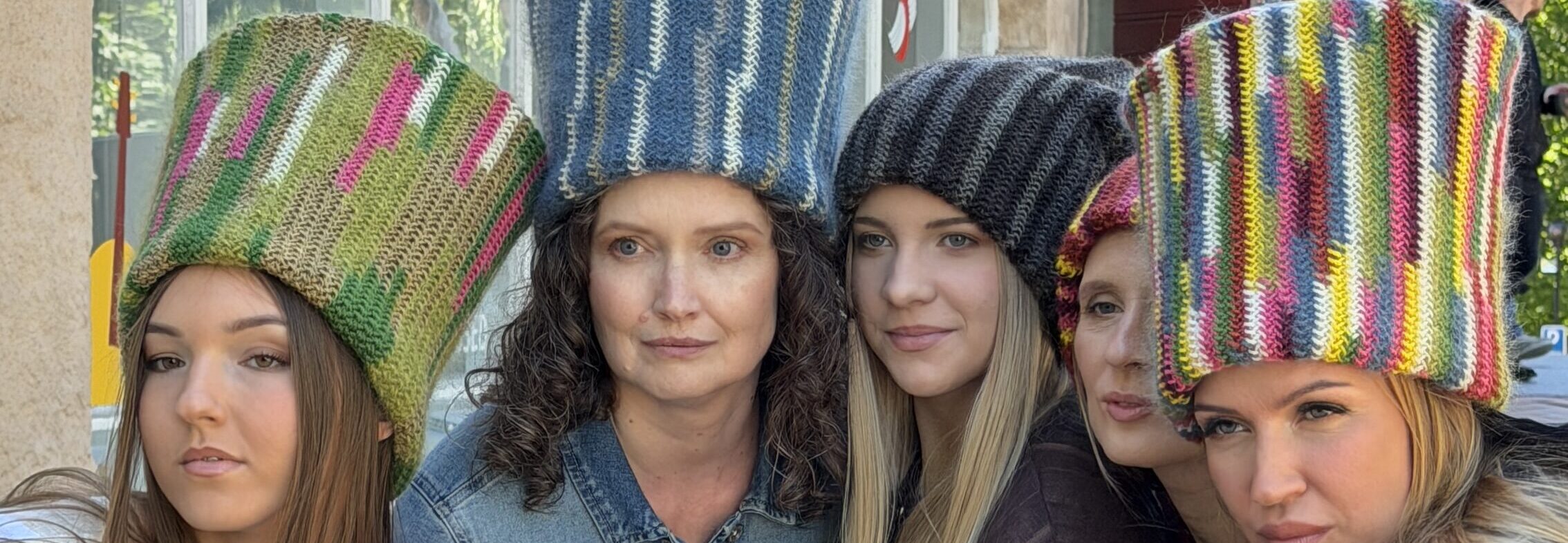
Items made using the needle technique have remained for the personal or close use of those who love heritage crafts. Not many items made using this technique are found in public spaces. Presenting and introducing the collection provides an opportunity to enjoy the uniqueness and possibilities of items made using this dignified technique. Eyeleting has been added to the heritage needle technique to achieve a double circular item that has many different uses. Since the technique is very time-consuming, such large items are not made. Thus, we invented an item that performs various functions: headgear – a hat/cap, a neckerchief/scarf, a shawl, a muff, a belt/back warmer, a bag warmer on a cold day or a cooler on a hot day, etc.
If one technique is so special and deserves special attention, then everything else should support it. The solution for making clothes was linen fabric scraps that had been waiting for their time for nearly 20 years, which are monochromatic and allow the natural-colored woolen yarns to shine. The design and production of the clothes have played with transparency and opacity.
We have also thought about showcasing the collection at a fashion show and created our own choreography for it.
Who is the collection intended for?
For a woman who appreciates timelessness, uniqueness and natural materials.
Are there any items in the collection that are suitable for a different body type than usual (e.g. larger size, different body shape, elderly, special needs, etc.)? If so, please describe these items and who they are intended for.
Accessories made using the needlework technique are a new creation that can be used as a collar, headgear, muff, belt, etc. They do not ask for age, size, or gender.
The waistband of the skirts is sewn with the “rubber-shirring” technique (author’s technique), which allows the skirt to be worn by different body types. The waistband, which stretches in this way, also allows the skirt to be worn as a dress.
What materials did you use and why?
The clothes are made of 100% linen fabric. These are defective, loosely woven blind fabric production residues and strips with woven edges created during the cutting. Katre Arula’s creations are largely made from production residues, in this case, fabrics that have been waiting for their time for almost 20 years are given value. Strips of fabric with woven edges of fabrics are also used, which, when sewn together, create the effect of a striped skirt.
The accessories are made from half-worsted yarn processed at the local small Muru wool mill from the Lahemaa Heritage House sheep’s wool. The yarn is spun specifically for needlework (i.e. z-twist). The shades are natural or dyed with natural dyes (onion peel, indigo, crape, cochineal, goldenrod).